Posted on
on March 23, 2026
on March 23, 2026

A meeting room should be a pleasant place to work. You want a clear view of presentation screens, plenty of natural light, and a space where people can concentrate. Yet many organizations view window treatments merely as a practical detail to be addressed at the end of a project. That’s a shame. The right window treatments in your office directly impact comfort, energy consumption, and productivity. In this blog, you’ll learn what to look for in sun protection for meeting rooms, which types of indoor sun protection are suitable, and how to find a solution that works in practice.
Meeting rooms have different requirements for window treatments than regular office spaces. In a workspace, a little sunlight is usually not a problem. In a meeting room, however, it can be immediately distracting. Take, for example, a presentation that becomes unreadable due to glare on the screen. Direct sunlight streaming through a window can quickly make a room too hot, but fully closed curtains block out the daylight. In short, appropriate sun protection in a meeting room is not an unnecessary luxury.
In many projects, sun protection isn’t considered until late in the design process. This results in solutions that may be technically feasible but aren’t functionally optimal. A better approach starts earlier in the design process. That way, you can integrate sun protection into the design of the facade, the track system, and the operating mechanism. This prevents the need for retroactive modifications.
Not every meeting room serves the same purpose. Some rooms are used for brief discussions, while others are used for presentations, video conferences, or training sessions. Nevertheless, there are certain features that effective office window treatments must provide in virtually any situation.
In addition to technical integration, it is important to consider how the space is used. Meeting rooms are often used by different teams and serve multiple purposes. As a result, window treatments must be flexible.
A well-designed system allows employees to easily adjust the lighting without completely darkening the room. This makes meeting rooms more comfortable to work in and prevents people from constantly having to adjust the blinds during a meeting.
Asking a few practical questions can help you determine the right solution:
Interior sun protection is used in various ways in office projects. The choice depends on the space, the amount of glass, and the desired level of light control. Nowadays, there is a suitable sun protection solution for every situation.
Vertical blinds are often used vertical louvers are often used. They are suitable for wide glass facades and provide a high degree of control over the amount of light entering the space. By tilting the slats, you can block direct sunlight while still allowing daylight to enter. This makes this system popular in meeting rooms with large windows. In addition, vertical blinds complement modern office architecture featuring large windows.
Roll-up blinds are a smart and efficient solution for modern office buildings. They contribute to a comfortable and productive indoor environment. The use of metallized fabrics effectively reflects sunlight, significantly improving heat protection. This helps prevent overheating and reduces the load on HVAC systems.
In addition, roller blinds can provide smart glare control. This reduces annoying glare on computer screens, creating a pleasant working environment where light, temperature, and comfort are perfectly balanced.
For projects where aesthetics play a more significant role, architects often opt for pleatedsystems or Duette®systems. These solutions combine an elegant look with effective light control. Duette, in particular, has insulating properties thanks to the honeycomb structure of the fabric.
In addition to their aesthetic qualities, both pleated and Duette® systems also offer functional benefits. For example, pleated fabrics are available in a metallized finish that reflects solar radiation, thereby contributing to effective heat protection. This helps maintain a stable indoor temperature and prevents overheating.
At the same time, both systems provide effective glare control, reducing annoying glare at workstations and on computer screens. This creates a pleasant balance between natural light, visual comfort, and energy efficiency.
In rooms where presentations are held regularly, additional lighting control may be desirable. In such cases, blackout systems come into play. These systems use special blackout fabrics that block virtually all light. This ensures optimal visibility of projection screens. In practice, blackout systems are often combined with lighter window coverings, so that the room remains comfortable even when no presentation is taking place.
In commercial construction, sun protection rarely stands alone. It is part of a larger whole that includes building systems, interior design, and façade design. In complex office buildings, sun protection must integrate with façade structures, glazing, building management systems, interior finishes, and acoustic solutions.
For architects and developers, this means that sun protection should be considered early in the design process. When systems are added only at the end of a project, practical or aesthetic problems often arise. For example, when mounting points are missing or when the sun protection does not fit well with the window layout.
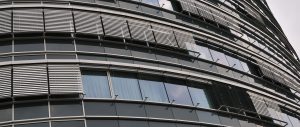
Many modern office buildings feature large glass surfaces. While this provides plenty of natural light, it also makes sun protection more challenging. For example, a standard system can cause problems when windows are of different sizes, when there are sloped facades, or when a combination of interior and exterior sun protection is used.
In projects like these, custom solutions are often the most practical option. This applies not only to the system’s dimensions but also to how the sun protection is installed and operated. At JEWEL, we specialize in these types of projects. By combining interior and exterior sun protection with smart rail systems, we create a solution that complements the building’s design and performs reliably in everyday use.
A meeting room is used by different people every day. Therefore, the best window treatment solution isn’t necessarily the most complex one, but the one that works reliably and is easy to use.
That’s why a successful project ultimately comes down to three things: smart product choices, thoughtful integration into the design, and meticulous execution. When these elements come together, the result is sun protection that not only complements the building’s aesthetic but also functions reliably for years to come. At JEWEL, we combine these elements every day in a variety of projects.
For organizations working on office projects, that’s exactly what matters: a solution that works both on paper and in practice. And when a project gets a little more complicated, it’s reassuring to have a partner who thinks along with you and says, “We’ll take care of it.” Contact JEWEL—we’d be happy to work with you.