Posted on
on March 23, 2026
on March 23, 2026

In office projects, sun protection is often not selected until late in the process. By the time the building is already standing and the interior design is practically complete, the question arises as to which solution is most suitable. In practice, this frequently leads to problems. Mounting points are missing, systems do not match the rest of the interior, the controls are not user-friendly, or the systems cannot be neatly integrated into the design.
An effective solution for office sun protection is therefore usually not developed after the fact, but rather during the design phase. When sun protection is incorporated into the plan early on, it can be tailored to the building’s architecture, the use of the spaces, and its technical systems. This is because sun protection affects user comfort, a building’s energy consumption, and the interior’s aesthetic appeal.
In this blog, you’ll learn why a good plan makes all the difference and how to choose the right types of interior sun protection for office environments.
Modern office buildings often feature large glass walls. While this provides plenty of natural light and creates an open atmosphere, it also presents certain challenges. Sunlight can cause glare, heat up spaces, and make it difficult to work on screens. That’s reason enough to address this issue promptly.
If this is not done, practical limitations often arise, such as insufficient space for installation, products that do not fit the window layout, illogical operating systems, or window coverings that simply do not visually complement the interior.
A well-thought-out plan for sun protection makes the difference between a solution that is merely technically feasible and a system that also works well in practice. By considering the building’s orientation, the use of spaces, and the amount of glass in advance, you can better determine which sun protection is most suitable. We’ll explain the immediate benefits of appropriate sun protection and provide you with several examples of solutions commonly used in office projects.
A good indoor environment directly affects how people work. Too much sunlight can cause glare on computer screens, while a room that is too dark can be tiring. Sun protection helps strike this balance. By regulating natural light, it creates a workspace where employees can work, hold meetings, and give presentations in comfort.
When it comes to meeting rooms and office workspaces, several factors come into play, such as:
A good sun protection solution takes all these factors into account. As a result, the indoor climate remains more stable, and users need to intervene manually less often.
Large glass surfaces are increasingly being used in modern office architecture. Examples include atriums, glass canopies, or veranda-like spaces within office buildings. Specific solutions are available for such structures. For instance, veranda shading can be used on glass roof structures or canopies. This helps limit heat buildup in these spaces.
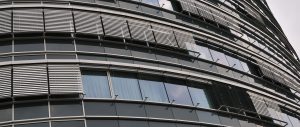
For facades that require a high degree of light control, external blinds are frequently used. These allow for precise control of light entry because the slats are adjustable. When modifications to the facade are less desirable, external sun-control film be a solution. This film is applied directly to the glass and helps reduce heat and glare.
Solutions like these demonstrate that sun protection isn’t always provided by a single system. Often, it involves a combination of technologies that work together to create a comfortable indoor environment.
In addition to exterior sun protection solutions for offices, there are various types of interior sun protection that contribute to comfort in an office. Interior sun protection is often tailored to the function of a space. For example, workspaces require light filtering without making the room too dark. Meeting rooms, on the other hand, may need additional control over light, especially during presentations. Interior sun protection can serve various purposes.
From reducing glare on computer screens to complementing interior design. By considering indoor and outdoor sun protection together, we can create a solution that better suits the needs of an office.
Interior or exterior sun protection—which is the best choice? In office projects, smart interior sun protection or a combination of both is increasingly being chosen. Exterior solutions block most of the heat before it reaches the glass, but are less practical to install in large buildings.
Interior sun protection can help regulate the amount of light entering a space. However, interior solutions can also provide effective heat protection. Metallized fabrics, such as roller shade fabrics, are also highly effective at blocking heat. With the right interior sun protection, you can achieve results very similar to those of exterior sun protection, but maintenance is much easier—especially when it comes to 20-story buildings.
Screens are widely used in modern office architecture. They filter sunlight while largely preserving the view to the outside. This keeps spaces bright without direct sunlight entering. Another solution is roller shutters. These systems are often chosen when additional blackout, insulation, or security is desired. In some office projects, these factors play an important role.
For buildings with windows that do not extend all the way to the floor, awnings can be a practical solution. They effectively block sunlight while still providing a clear view of the outdoors. By effectively combining exterior sun protection with interior sun protection, you create a system that effectively regulates both heat and light
For architects and contractors, it is not only the product itself that matters, but also how the sun protection system is integrated into the building. In commercial construction, sun protection systems often need to be coordinated with facade structures, mechanical and electrical systems, automation, and building management. Proper technical integration prevents problems during installation and ensures that the systems continue to function reliably.
For larger projects, it is therefore important to collaborate with partners who have experience with these types of issues. By contributing ideas on technical details from the outset, solutions can be developed that align with the building’s design.
Good office design is about more than just aesthetics. Comfort, ease of use, and energy efficiency play a major role in how a building is experienced. Sun protection contributes to all of these aspects. It helps regulate natural light, keep heat out, and make spaces comfortable for employees and visitors.
A well-thought-out plan results in a solution that is tailored to the building and its daily use. JEWEL is happy to assist you in developing a flawless plan. We take into account all the key aspects of sun protection for your office building and come up with a solution that works.